Pages

Sudden Changes in Demand and the Great Inversion

I've been making my way through The Great Inversion by Alan Ehrenhalt. His main thesis is that the majority of the changes going on in central cities, which is occasionally attributed to gentrification, are actually symptoms of a more systematic demographic inversion taking place across the country. This process is fairly quickly reversing a decades long trend of suburbanization to create new American cities that more closely resemble those of nineteenth century Europe.

This is an extremely apt observation. While gentrification as a process occurs, it's important to put it into a larger framework of what the root cause really is. It always has taken as its assumption a changing pattern of demand (coupled with a potential value in urban land not currently realized), and Ehrenhalt's analysis of what this means for downtowns, exurbs, and everyplace in between is extremely enjoyable.

One thing I still found missing from the analysis is a clearer explanation of why this change in demand is occurring. The demand created by aging boomer parents is fairly apparent, but it isn't so with millennials. For millennials, Ehrenhalt included anecdotes of college students polled showing a preference for living in the city, after watching Seinfeld and Friends from the safety of the suburbs.  While I'm sure this happened to many American college students, I still think there is something broader to be said about the general change in urban demand among millennials without falling back on the story of the bored suburban kid rebelling by moving to the big city.

A possible explanation for this change in demand is the fact that suburban growth was always in essence a ponzi scheme. Demand for the suburbs was dependent on the fact that demand for suburbs would always continue among later cohorts. The analogy I would draw is a line that is constantly growing longer. You'll more willingly get on line if you see people will gather behind you. The wait doesn't seem too long when compared to the growing number of people behind you. Whatever inconveniences you have to deal with in your suburb is mitigated by the fact that people are still moving further away than you, and they have it worse out there.

Of course like any ponzi scheme, collapse is inevitable. Once this process stops, demand for suburban areas as a whole ends up suffering. Exurban areas immediately feel the hit, as they have during the latest housing crisis, and other suburban areas are forced to adapt in the myriad of ways Ehrenhalt describes, which depends on whether the metro area is growing, stagnant, or declining, and how far out the area is.

This ends up describing both why this change is happening now, why it seems to be happening to millennials (it would happen to any cohort in our position), and why the change seems to be happening so suddenly.
Read more ...

Parkchester: Bad Urban Planning at its Best

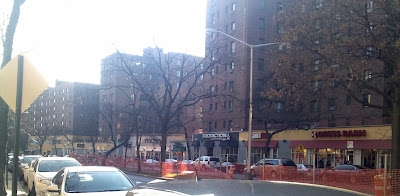
I took these pictures of Parkchester in the Bronx the last time I was biking in the area.


Parkchester was built as a middle income housing project, similar to Stuy Town in Manhattan. On the surface someone would probably classify the development with other failed urban renewal schemes styled as "towers in the park," but there are some positive qualities that set Parkchester apart from comparable projects and developments.


Unlike other developments, Parkchester has two fairly major streets passing through it: Metropolitan and Unionport


While a lot of the smaller dead ends within the complex are very sparse, and contain only building entrances set back from the street, the main streets serve as commercial arteries that interact with the towers very successfully in my opinion.


In the Death and Life of Great American Cities, Jane Jacobs prescribes inserting a grid into the parkland, and replacing the footprint of the spread apart towers with storefronts closer in. I imagine if lower income projects in New York ever were remedied in this way, it would look a lot like this.


Jacobs framed this as more of a "best case" for integrating towers into a neighborhood, while favoring the smaller scale of her native Greenwich Village. I think this is an example of how nuanced urban planning problems can be. A place like this is a more vibrant and accessible community than Greenwich Village today, and it gives hope that urbanism can survive in areas that on paper may seem like urban wastelands.

Check out Forgotten-NY's post on Parkchester as well for some pictures of its whimsical art.
Read more ...

More Thoughts On Why The Rent Is Too Damn High

I actually wrote my last post before realizing that it was one of the central ideas in Matthew Yglesias' book: The Rent Is Too Damn High.  I'm really glad that the this relationship between development and rising rents, or as Yglesias calls it "the mirage of gentrification", is getting more popular exposure.  Hopefully this, combined with the numerous other calls for increasing densification will actually have an influence on public policy.

While Ryan Avent and Edward Glaeser show the simple case that allowing development will alleviate rental prices, Yglesias' continuation of the theory to explain WHY policy makers think development causes higher prices is the key of why development continues to be fought.  One added problem here is what I explained in my last post: any cause of NIMBYism strengthens the perceived link between increases in density and rent prices.

In this way, Charlie Gardner is right in his take on this book: cities can't simply "build" their way to affordability.  They can build their way to relative affordability, but there will always be a relationship between denser city center and unaffordability.

I plan to do a lot more thinking on where exactly denser development should be occuring.  I'd like to suss out whether it's more useful to build more housing units in a city core or just outside a city core.  One thing to note is in order to increase affordable housing, it makes sense to start at a location where housing prices are simply high and not astronomical.  

In the coastal cities, there can never be enough development in major city centers to handle the demand to live in prime locations.  In some coastal cities (though not all) you also have a steep drop off in density, meaning outside of the core areas the metro area is more spread out and can't take advantage of the economies of scale you get with density.

Perhaps instead of building up an area like Manhattan, we should try to make other areas like Manhattan.  For recently gentrified outer borough neighorhoods, realize that they were gentrified for a reason.  Instead of building up those areas with the intent of making them more affordable, develop the already affordable frontier neighborhoods to make them more desirable.  While I agree that we should remove a lot of restrictions we have on development in central cities, this additional policy focus will help the entire region become more liveable, and thus make more liveable areas affordable.
Read more ...

The Key Fallacy in the Debate Surrounding Height Restrictions


Emily Badger at the Atlantic Cities writes a balanced piece on the debate surrounding height restrictions in cities.  On the one hand, we have density being a quality that provides positive externalities for cities by itself and should be encouraged, while on the other you have the negative effects of density such as loss of sight lines, possible increases in congestion, and increased use of city services.

One thing she throws in somewhat casually however, is that this increased density may raise rents.  I've previously written about this fallacy in a different context, but this is a purer example of how this kind of thinking can be damaging.  Densification has both positive and negative externalities, and these deserve to be compared to come up with a more coherent plan on how to maximize density while minimizing the negative side effects if may lead to.  Rising rents simply isn't one of these negatives.

The problem is rising rents and densification are definitely correlated in most practical cases, and wouldn't be in a purely theoretical context. Instead of densification causing rising rents however, they are both caused by an exogenous increase in demand. Whenever you have restricted development (which is pretty much the only type of development that can happen in a city), an exogenous increase in demand will lead to a pent up need to increase supply. Because development is limited and supply is not able to catch up with demand, prices will rise.

When you compare this to more stagnant areas which have no increase in demand, and therefore will have no invasive development and no increasing prices, one can erroneously think that the development in the more popular area is what caused the high prices.

This sort of dynamic can be dangerous because it feeds into itself.  The more restrictions in place, the more pronounced this effect will be.  This means that the cities that are more predisposed to restrict development will seemingly be proved right more than those with more lax restrictions.

I'd even go farther with this line of reasoning.  I'd argue that restrictions on development could increase the other negative effects of density.  A developer without restrictions might be more able to make their property more desirable than others; they'd add some public space, or build more aesthetically pleasing buildings.  If a developer is constrained, they'd be more focused on squeezing in as many units as allowed by law, perhaps at the expense of those more aesthetic effects.  This only adds to the feedback loop, and the city will be again be prompted to restrict development further.

The only way out of this is to realize this connection simply does not exist, and to try to completely divorce housing prices from arguments about densification.  Despite what evidence may suggest, prices are still driven down by increases in supply.  While I personally believe there should be less restrictions on development, there are still valid arguments to be made on the pro-restrictions side.  Rising rents simply isn't one of them.
Read more ...

Adventures in Gerrymandering

Gothamist ended up getting their hands on the newly redistricted State Senate and Assembly districts.  While they posted some examples of primo gerrymandering, the district including the neighborhood I grew up in caught me as particularly flagrantly drawn:


I grew up here so it was immediately apparent why this shape was chosen.  Here's a hint.


District 34: The White-People-Who-Live-in-the-Bronx-and-Some-White-People-from-Pelham-So-It's-Not-Too-Obvious-That-We-Literally-Drew-This-District-Based-On-Race-But-Ew-Make-Sure-You-Don't-Include-Mount-Vernon-It's-Kinda-Sketchy-There-If-You-Know-What-I-Mean District.

This is why I just can't get into politics.
Read more ...

Infrastructure for the Future

The A Train, going through an empty field.  Picture from Forgotten-NY.com
I've been thinking a bit about how forward looking city investment has been, how this sort of thinking changes over time, and what factors might lead to changes in the "forward looking-ness" of this sort of investment.

At first I didn't even really consider changes, and considered the effect more exogenous.  I would think that it's simply politics, something that changes at the whim of society, and ends up framing how long term investment ends up happening in a city.

The one example that always gets me considering this is the New York City subway system.  I would always think how ridiculous the current capital projects are when you compare it to the subway's history.  Subways were originally built to farmland.  There was no existing demand, it was assumed that people would begin moving up there around subway lines as the city developed.  

Today, the MTA is officially working on two line extensions entirely within Manhattan, one of which through the densest neighborhood of Manhattan.  While it makes sense to build infrastructure where it will benefit the most people, and that place is exactly where the MTA is working on it, it's obvious that the subway was formerly developed for FUTURE use, and with an eye out for how the subway would effect the development of the city.

Looking at this degree of forward future consciousness a bit more however, I ended up coming up with a few alternative explanations.  one is the fact that the subway was originally developed by private companies that had their own real estate interest, where it makes sense to build subways to your own developments where remote land is cheap, whereas now the MTA is more controlled by the government which exists to serve the current population.

More interesting however, because it's a relationship that can be tested elsewhere, is simply the fact that development becomes less forward looking as cities or infrastructures themselves age.  A blank slate lends itself to grand plans without precedent, while an older city and infrastructure is thought of as "set" and the framing of any investments change from future inhabitants to the current inhabitants.

This is interesting because it's obvious we should always take these future considerations into account, and if this relationship really does exist, then there is some sort of systematic bias towards stagnation in older cities that can be predictably accounted for.


Read more ...

Home Ownership Alternatives

There have been a few posts at Atlantic Cities considering the "forever renter".  The subprime crisis has caused a major reevaluation of the risks of home ownership.  In a world where housing prices are not guaranteed to go up forever, does it make sense to leverage yourself so heavily on a single investment?  If stable "organization man" careers are replaced by constant change, does it make sense to tie yourself down to one location?

While it would seem the new economic reality is stacked against homeownership, there are still some non-economic downsides to a life of renting.  Emily Badger writes about a few of these concerns, explaining the non-economic indignities that renters suffer.  There is a psychological toll to not being able to paint the walls or hang paintings on nails, and a huge psychological benefit from the feeling of owning the space where you live.

I think it's important to distinguish between the economic and psychological side of home ownership vs renting. Some of the comments explain alternative agreements between landlord and tenant, which is a completely non-economic consideration.  It's interesting to think about how much of the landlord/tenant relationship is culturally determined, and how this can mitigate the feeling of missing out on home ownership.

There are separate economic considerations however.  Home ownership is partially an investment, and since a house by itself is technically a depreciating asset, the investment is in the neighborhood.  Home owners benefit from an improving neighborhood, while renters get priced out.  Home owners care about maintaining their neighborhood and are incentivised to become active citizens, while renters would experience any positive changes as rent increases.

I've considered this situation before, and have always wondered why housing as an investment can't be decoupled from your home.  I've thought of a few plausible alternatives to the standard model of home ownership we have in place today.

Home Ownership as a Completely Flexible Share-based Equity Investment

If I would like to invest in my neighborhood, why is my only option to leverage myself and buy a house?  Amanda Erickson writes about NYU professor Andrew Caplin's idea of housing partnerships, which I believe partially touches on this idea.  In my opinion he still seems to frame his idea as a way to invest in a fraction of YOUR home, along with the help of an institutional investor.

Whenever I've considered this sort of option, I've thought it should be framed as an investment for the occupant as well.  Buying shares in your house is a hedge against rising rent: as rents go up, the value of your investment will go up as well and partially offset the rent increase.  Viewing it in this way is key in my opinion.  With this framing it would make sense to live in one rental building and buy shares in the building across the street.  It gives you full control over how much you want to put into your investment.  The decision on how much you would like to hedge your rent would be based off of so many new variables, such as the amount of time you spend in a particular place, and your future expectations on gentrification within the neighborhood.

This also allows a person to diversify their housing investments.  It's insane that we ever thought it was a good idea to leverage yourself on an investment in ONE house.  Perhaps you'd like to invest in several neighborhoods in your own city to protect yourself against the risk of housing prices in your home neighborhood declining in value.  Or, you can invest in comparable neighborhoods across different cities, to hedge against any city specific variation that might adversely affect housing prices.  The opportunities are endless.

Rent Stabilized Leases as a Commodity

I actually began thinking about this issue as a result of considering the effects of rent stabilization laws, and my first particular solution involved a revamping of this system.  Economists generally view this as they would any other price control.  The artificially low price of rent stabilized apartments makes them extremely hard to come by, the lower supply of market rate apartments cause all non-rent stabilized rents to be higher than they should be, and the fact that rents can't rise discourages investment by landlords into rent stabilized buildings.  Overall, it seems to be bad policy.

However, rent stabilization is a guarantee that your rent won't go up, which is the main risk you'd be hedging against in the housing share situation I described above.  This guarantee creates a sort of permanence that one would normally only get with home ownership.  Rent stabilized tenants have the same incentives as home owners to become active citizens and improve their communities.  In both cases they will reap the benefits of their improving neighborhood.

The economic distortions caused by the current implementation of rent stabilization disappears if these leases can be bought and sold.  Rent stabilized leases would be priced based on expectations of future increases.  Assuming a lease is being sold directly by a landlord in a previously market rate building, the landlord is compensated for his restricted lease.  The benefits of an improving neighborhood get moved from the landlord to the residents, which actually a better incentive system overall and avoids problems of "absentee landlords".

Over time, this will create an amazing variety of housing options.  As rent stabilized leases grow older an more out of touch with current market rates, their values will increase.  At any point, landlords could buy back their leases and create new ones based off of current market rates.  A wide spectrum will develop between pure home ownership and non-regulated market rents.  The first few rungs of the "housing ladder" will be lower, people can begin to buy less expensive regulated leases closer to the market price, and can work their way up to full home ownership over time.

Of course there are hurdles to implementing a system like this.  There is no clear answer to how to transition existing rent stabilized leases (in this case who "owns" the lease?)  Once in place however, it is a great way to keep the positives of rent stabilization such as stability and a renter's stake in a neighborhood, while getting rid of the market distortions rent stabilized leases causes.
Read more ...